
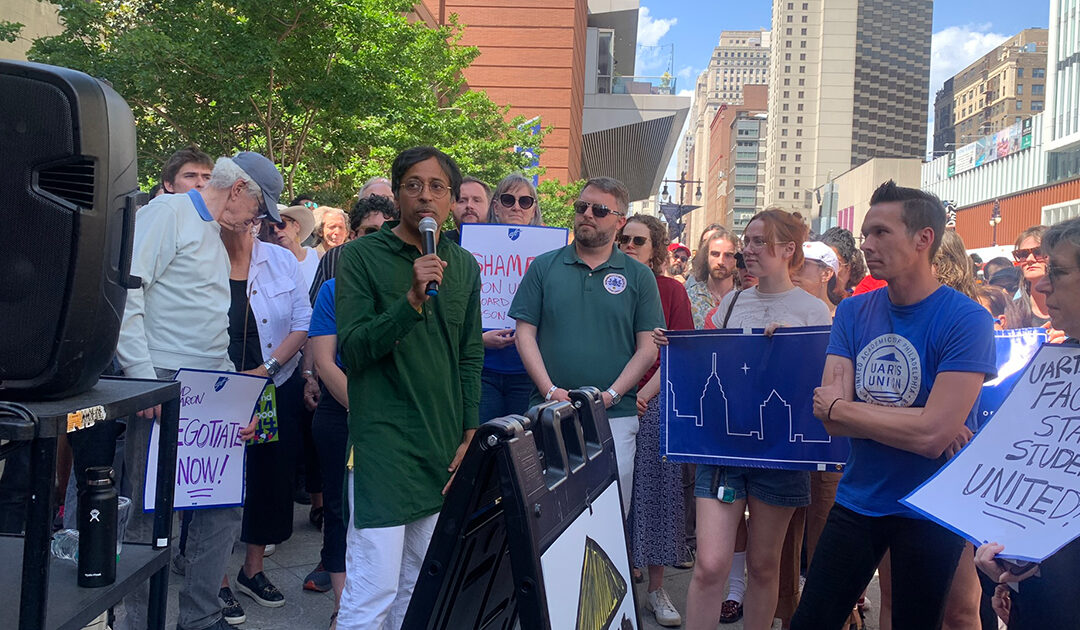
The recent closures of some of Philadelphia’s most treasured cultural institutions, including the Academy of Natural Sciences museum, underscore the need for sustainable funding for the city’s vibrant arts and culture sector. Saval’s proposal allows the city to generate new revenue that can be distributed directly to arts organizations, cultural institutions, and civic centers.
PHILADELPHIA, PA − November 12, 2026 − Today State Senator Nikil Saval (D–Philadelphia) announced legislation to establish a dedicated, sustainable source of revenue to invest in Philadelphia’s renowned arts and cultural sector.
The proposal comes in the wake of the closure of Philadelphia’s beloved Academy of Natural Sciences museum in September, which was met with public shock and outrage and reverberated throughout cultural and scientific communities across the world. The museum’s closure, following so soon after the closures of the Philadelphia History Museum (known previously as the Atwater Kent Museum) and the University of the Arts, underscores the urgent need for action.
A recent study by SMU DataArts found that compared with peer cities, Philadelphia ranks last in public arts funding. For years, artists, advocates, and cultural workers have sounded the alarm on the lack of investment from the city and the state.
“Philadelphia is known around the world as a hub of arts and culture, with exhibits and performances that represent the highest form of their medium and interrogate the whole of human experience,” said Saval, who serves as Democratic Chair of the PA Senate’s Urban Affairs & Housing Committee and leads its Philadelphia Delegation. “The decades of underfunding threaten the cultural and economic vibrancy of our city and the stability of our communities. We have an opportunity to make a generational investment in our arts and cultural institutions, parks, and civic spaces—preserving these treasured community assets and expanding public access. We can ensure that public money goes to support the public good.”
Saval’s proposal would enable the City of Philadelphia to make an increase in its sales and use tax, capturing a small portion of each dollar spent inside the city’s geographic boundaries and returning it to neighborhoods and communities. Museums, galleries, theaters, parks, recreation centers, libraries, and other public assets would be eligible to receive funding.
The proposal draws from Allegheny County’s Regional Asset District (RAD), established in 1993 as a way for the county to preserve its struggling cultural institutions. Allegheny County enacted the RAD with a 1% increase in the county’s sales and use tax, generating more than $5.5 billion over the past three decades. These funds have been fully reinvested in communities throughout the county and created a sweeping change in the county’s cultural landscape.
Adapting this model for Philadelphia will create a dedicated source of revenue to stabilize important community assets by supporting steady operations, reducing dependence on one-off and limited-scope grants, and allowing, for the first time, the possibility for long-term planning and sustainable growth.
“Philadelphia’s arts and cultural sector is at a critical crossroads, and we cannot continue to rely on short-term solutions to address long-term challenges,” said Patricia Wilson Aden, President and CEO of the Greater Philadelphia Cultural Alliance. “Senator Nikil Saval’s proposed legislation is a vital step toward securing the sustained public investment our arts, cultural, and heritage organizations need to thrive. Making a dedicated arts fund a reality will require collaboration across all levels of government, and our cultural community, and the Cultural Alliance, stands ready to work with Senator Saval, the Parker Administration, City Council, and our partners to achieve this long-standing goal.”
“A city is defined not only by its infrastructure but by its imagination and creativity. Arts and cultural organizations are essential to the heartbeat of our city—critical to individuals, communities, and Philadelphia’s core identity,” said Jane Golden, founder and former Executive Director of Mural Arts Philadelphia and long-time advocate for the city’s arts. “This important legislation recognizes that culture is not a luxury, but an essential public investment in the long-term health, vitality, and future of our city. I have literally jumped up and down for years proclaiming that art ignites change, and I have had the extraordinary honor of seeing that happen firsthand. This legislation affirms what I have believed throughout my career: when we invest in culture, we invest in people, in possibility, and in the kind of city we want Philadelphia to become.”
Philadelphia’s arts and culture sector has an economic impact of $2.2 billion and creates tens of thousands of jobs. Millions of people travel to Philadelphia each year to attend in-person events, enjoying the city’s restaurant and hospitality industry, participating in local retail and commerce, and taking local transit. Saval’s proposal would amplify the reach of each dollar spent in Philadelphia, expanding public access and allowing for the sector’s growth.
April Gigetts, President of AFSCME District Council 47, and Halcyone Schiller, President of AFSCME DC47 Local 397-Philly Cultural Workers United, represent workers whose labor supports the success of cultural institutions, libraries, and recreation centers throughout the city.
“As the largest union of workers in Philadelphia’s museums, libraries, and zoos, we know Philadelphia’s cultural institutions are vitally important to the lifeblood of this city and have been since its founding,” said Gigetts and Schiller in a joint statement. “Yet disinvestment in our time threatens to change Philadelphia forever. When it thrives, our city’s arts and culture sector supports tens of thousands of jobs, enriches residents’ quality of life, and attracts tourists from all over the world. But it is not thriving. The closure of the two-hundred-year-old Academy of Natural Sciences museum is a wake up call. We applaud Senator Saval’s vision of sustainable funding for Philadelphia’s arts and cultural organizations. Philadelphia’s cultural workers call on all our political representatives to rise to the challenge of this moment and work with Senator Saval to save Philadelphia arts and culture.”
Pennsylvania’s incoming democratic trifecta opens a historic opportunity to act on behalf of Philadelphia’s communities. During the last democratic trifecta, Pennsylvania passed crucial policy that directly supported residents, including creating the Community Life Improvement Program (CLIP), making the Low-Income Housing Tax Credit (LIHTC) permanent, and establishing Allegheny County’s RAD.
Recently, Philadelphia voters signaled their support for a measure to codify the arts within city government with overwhelming approval.
“It’s clear that the public has the will to fight to preserve our vital community assets,” said Saval. “Philadelphians now need their elected representatives to fight for the city’s future, too. We have a historic opportunity to make a permanent change in Philly’s cultural landscape.”
The full text of the co-sponsorship memorandum is available here.
###
Senator Nikil Saval is a father, husband, writer, and organizer representing Pennsylvania’s First Senatorial District. Serving as Democratic Chair of the Senate’s Urban Affairs & Housing Committee and Chair of the Senate’s Philadelphia Delegation, Saval’s legislative work is focused on critical response to Pennsylvania’s housing, mass incarceration, wage, and climate crises, while simultaneously pushing for deep structural change. He is fighting for a Philadelphia and Pennsylvania that work for everyone.
Learn more about Senator Saval on his website, and follow him on X, Instagram, and Facebook.